Monday, March 07, 2016

A capital day out

It was quite disappointing that we weren't able to take a day trip out to Kapiti Island, particularly because the call cancelling our trip came about half an hour after we had checked in for two nights at a campsite in Paraparaumu, which is close to where you catch the boat from Kapiti Island, but has no other particular charms to recommend it. (It's about 45 minutes from Wellington, and has a beach in all fairness, although not an amazing one.) We had already been told that our motorhome was too big to park in the central Wellington park though, so it wasn't a complete waste of time being in Paraparaumu.

Jules had had his heart set on seeing the rare native birds at the Kapiti Island sanctuary, so we rejigged our plans slightly to go to Zealandia, known back when I lived in Wellington as the Karori Bird Sanctuary. This rather snippily notes on its website that no boat trip or permit is required to go there, which on this particular day was definitely a selling point.

The anti-predator fence keeping the Zealandia wildlife safe

After a look around the indoor exhibition, which contained a lot of background information I knew already, but also tidbits that were new to me, such as that native NZ frogs hatch as fully-formed baby froglets, rather than tadpoles, we headed on a guided walk.

I was kind of expecting the birds to be more in your face than they were for most of the time, with the exception of some playful kaka (we heard a French family laughing at that name) and, surprisingly, a pair of takahe. Takahe are very rare, with only around 250 known survivors. These two were obviously pretty used to the company of humans, having previously been part of a breeding programme on an island sanctuary before "retiring" to Zealandia. It was really a privilege to be able to get so close to them for so long.

Making friends with the Takahe


We were actually ready to leave the area sometime before we did, but were trapped in with the takahe between us and the gate. When I first saw the sign asking visitors not to let the takahe through the gate, I was imagining timid birds that would scatter at the sight of humans and spend most of their time hiding in the bushes. These two were quite happy with people milling around them though, and I even saw one of them stick its foot and beak out of the gate before realising he wouldn't fit. Even though they're flightless, no-one wants to be the dolt that let the takahe out, so we stayed inside until a tour group came the other way through the gate and herded the takahe away.

Plotting his escape

At first, I found it a bit frustrating trying to spot the other birds (and lizards). Often, I couldn't see them even when other people were pointing straight at them, or I'd catch a glimpse only for them to fly away. I got a bit better at finding them over the hours we spent in the sanctuary, however, and came to appreciate the challenge of finding and identifying the birds, with the help of what we had learnt on the guided tour.

The guide showed us how, if you scuffed up the forest floor to uncover insects, you could get a native robin to fly down to eat. It was a real thrill (genuinely!) later when we found a robin, and, with much hoofing of leaves, got him to briefly come down for a snack. I have a new-found respect for bird-watching types.


The kaka's weight on the platform opens up his food box for a snack

And he's also provided with a drinks station

A kakariki on top of its feeding station

The robin we lured to the ground

A nest of shags aka cormorant

A tuatara sunbathing. The beads on his neck are ID labels, not his natural plumage!


After the sanctuary, we caught a bus into the city centre to visit some of my old haunts. It was fun to see what had and hadn't changed, and point out the various drinking establishments I frequented as a student and one that I got kicked out of. I can't remember why specifically, but I was definitely hassling All Black Ma'a Nonu. I must have been drunk, since in general I neither recognise nor care about All Blacks.

Wellington seems pretty hipstery these days, but retains its general vibe of a nice place to live. Jules got a haircut, I got my nails done and we both did some shopping, before grabbing a cocktail, watching some of the street performers on Cuba Street and visiting the Wellington Night Market. We were lucky with this one, since it's only on Friday nights. I don't think it existed back in 2008 when I was there. It was pricier and maybe not quite as bustling as Bangkok's Chinatown, but more cosmopolitan in a way, with a wide variety of different cuisines available (I know I'm not comparing apples with apples there). We feasted on pork-stuffed Chinese buns, a burrito, Chinese dumplings and jerk chicken, and could have sampled many other cuisines, from French to Japanese to Filipino.

All in all, a pretty decent day out, and it definitely helped us get over the disappointment of missing out on Kapiti Island. (Oh, and it was windy enough to perceptibly shake our motorhome on the drive back to Paraparaumu, presumably furnishing the explanation for why we couldn't go to the island, despite it being otherwise a pretty nice day.)

Saturday, March 05, 2016

Back to the foodture

One thing about being an expat, especially someone who has lived in multiple different cities and countries, is that there’s always something to miss. People, places, languages, culture, but most importantly, food. Depending where I am and my mood, I might be missing the delicious raspberry financiers from my favourite bakery in Tours, Galaxy Counters from the UK, chocolates from Belgium, and a whole host of things from New Zealand. Wandering the aisles of any large supermarket in Europe, you can generally come across at least some of the home treats you’re craving, with the sad exception of anything particularly New Zealandish, which is not big enough of a player to feature in a Brussels supermarket. Hence I came to New Zealand armed with a long (mental) list of things I had to cram in my belly before we left again, a list that just seems to get longer every time I walk into a supermarket or cafĂ©.

But… and here’s the rub - what percentage of the longings is mere nostalgia, and what is based on sheer deliciousness? On a podcast I listen to sometimes, comedian Richard Herring asks “Kettle chips used to taste a lot better - have I changed, or have they?” This is a question I have had occasion to ask myself over the past few days.

If you don’t care about New Zealand classic cuisine of my youth, which you probably don’t, you can bail now. Or, if you’re curious, join me on a journey of culinary (re)discovery. And try not to judge.

Georgie Pie


"Blow before you bite"

Ah, Georgie Pie. Back in the heady days of the 80s and 90s (and 70s, apparently, but I wasn’t around to see it), New Zealand had its own brave fleet of meat pie-based fast food restaurants. It was cruelly crushed by McDonalds, who bought the chain out and closed all its branches. In my absence, McDonalds has brought back the brand, only as a menu item at its normal outlets. I went for a standard mince and cheese, my pie of choice in all circumstances (and one, weirdly enough, they seem not to have in the UK). The crust and oozing yellow liquid cheese were much as I remembered, but the “meat” filling had a disturbing texture, or to be precise, lack of texture, as if someone had pre-chewed the filling and spat it back into the pastry shell. It didn’t taste too bad, but the texture ruined this one for me.

Buzz Bars


Now here is an unqualified success. I had thought that Buzz Bars were no more, since I had asked my mum to bring some over to Europe for me and she told me they weren’t making them anymore. Lies, foul lies and deception! This delicious, thin marshmallow bar covered with honey and a chocolate coating is still going strong and is just as good as I remember. Jules is also now lamentably addicted.

Afghan biscuits


I’m not a huge eater of biscuits, but I’ll always find a little corner for this Kiwi baking classic. Afghans are made with crushed cornflakes and no rising agent, so they have a slightly crunchy, grainy texture which remind me a bit of a French sablon, except way better, obviously. I tried to make a batch one year for Anzac Day, but as with all my attempts at baking in Europe using NZ recipes, it failed, spreading into one giant, crispy burnt mess. Apparently the grade of flour used in Europe is different, or I just suck.

My sad attempt
Jules (and my Mum - strike two) insisted afghans have the texture of cardboard, but they are wrong.

Lamingtons


Another Kiwi dessert treat that did not go down too well with Jules. Basically just a square of sponge cake covered in a mysterious layer of chocolate or raspberry then rolled in coconut (and sometimes filled with whipped cream and a blob of jam). They can be dry, as with all sponge cakes, but the mini one I had was a goodie. According to Wikipedia, they are also popular in Cleveland, where they are called coconut bars, which seems odd. Can anyone confirm?

Fish and chips

(Greasy) fish and chips on the beach at Tairua


NZ fish and chips are the best in the world. Forget that greasy, weirdly battered junk you get in the UK and come to NZ for the good stuff. So far we’ve had snapper and terakihi, which were both firm and flakey and white, just as they should be, covered in a batter which it’s hard to describe without sounding gross, so you’ll just have to believe me that a crispy outside hiding a thick layer of creamy white fat is the only way to go. And delicious fluffy chips, as good as any I’ve had in Belgium. (Did you see Angela Merkel at the famous Brussels friterie Maison Antoine last week? Better than those.)

Whitakers chocolate

Seems legit

I’m aware this list is full of horrible junk food, just bear in mind what I said about not judging, and also that it’s the first time in over 6 years I’ve had most of this stuff. Cadbury also has a large presence in New Zealand, with more varieties available than in its UK home, but Whitakers is the true local player. When I was a kid, they only made the deliciously chunky bars of Peanut Slab and Almond Gold, but they now make a full range of chocolate blocks. We’ve only had Coconut Rough so far, but we’ll be back for more. Definitely on the “still good” list.

Jelly Tip icecream


I’ll admit to being biased here. I had already read complaints online that Jelly Tip - literally a tip of raspberry jelly (Jello) on a vanilla icecream, covered with chocolate, wasn’t what it used to be. So I was perhaps primed to be disappointed. But I found the jelly a pallid imitation of what it used to be, colour-wise, and also not as flavourful as I remembered. The crisp chocolate shell still had the weird mouthfeel of compound chocolate, which I like, but which probably is a nostalgia thing. 

Lisa’s hummus (etc.)


At home, I normally make my own hummus, but here the Lisa’s range is hard to beat, especially because she has such a wide range of delicious hummus (beetroot! basil! caramelised onion!) and other dips (the aubergine and cashew and spinach and feta are especially to die for). These on toast have been my regular breakfast food so far. Definitely in the good list.

Onion dip


This was one of the treats at our family BBQ on the weekend. Take a can of reduced cream (like the stuff you see in Europe, but unsweetened, which I can never find), mix in a packet of dry onion soup mix, and chill. I think you maybe do this in the US too, but for me it’s always been a quintessentially Kiwi party food. Dangerously addictive.

Marmite


Oh, Marmite, you dark seductress. It shouldn’t really be on this list, since I have some in the cupboard back in Brussels, and I haven’t actually eaten any here yet (I bought six large jars to ship home though), but I couldn’t write about New Zealand food without including everyone’s favourite yeast extract. Salty and delicious, and nothing like the abominations of English Marmite or horrible Australian Vegemite. My one true love.

Thursday, March 03, 2016

Peach teats

Wai-o-Tapu was a pretty full-on morning, so we were both pleased to only have a short drive to our next stop, Taupo, where again we were getting out of the van for a night on terra norota. This time, we were staying at my parents' place, which is actually up for sale. It just so happened a real estate agent was showing prospective buyers around when we turned up, announced (politely, of course) that we were staying there and that it was our first time visiting the house. The real estate agent finished up and left without checking our credentials at all, so I think I might be on to a great scam here. Just turn up to an open home, tell them you own the place and then ring up a few days later with a funny voice and tell them you're taking the property off the market. Badda bing, badda boom, free house! Flawless plan. (Or at least just wait until the agent leaves and then steal a lot of stuff.)

We had two reasons for visiting Taupo - my parents' place and I have a cousin living there. Otherwise, it had usually been a drive-through kind of place on my itineraries through the North Island. Which is kind of crazy when you look at it, because although the town itself isn't the prettiest, it's on the edge of a huge and beautiful lake, fringed with impressive mountains.


There's even a bit where you can try to get a hole in one on a floating green!

The photos just show a tiny slice of the lake. I think you have to drive around Lake Taupo to fully appreciate just how big it is - 616 square kilometres. More impressive than its size is the fact that it occupies a volcanic caldera formed by the eruption of a supervolcano about 26,500 years ago. This was the largest known volcanic eruption in the last 70,000 years. It's truly impressive to sit on the edge of the lake and think that here was once a massive volcano, and to imagine the forces required to create a huge crater where it once sat. And there on the horizon are the volcanoes of Ruapehu, Ngauruhoe and Tongariro, as a reminder that New Zealand is still very much prey to volcanic and seismic activity.

In fact, I and my family were there during one of the most recent major eruptions of Mount Ruapehu, during the night of 25 September 1995 (celebrating my parents' Silver Wedding anniversary). We were staying at a hotel at the foot of the volcano, so had to be evacuated off the mountain. It wasn't a spectacular firey eruption, rather ash clouds, gases and mud flows (lahars), but still a pretty good story!

Driving on towards Wellington the next day, we got to get a better view of the mountains from the Desert Road. I teased Jules a little bit with this one, implying we were going through a real desert. In fact, it's just an area where little vegetation grows, due to the impact of volcanic eruptions through the centuries (I actually thought it was because of lack of rainfall, but apparently that's not true, it's because of the poor quality of soils and seeds and dry winds). Whatever the reason, it makes for a very different and impressive landscape. The variety of landscapes in a relatively small country is one thing that makes New Zealand so special.

With Mt Ruapehu, the erupty one


Ruapehu and Ngauruhoe (and Tongariro??)

The Desert Road

A van with a view!
Heather on the Desert Road

Mmm, Peach Teats. Calves love 'em!

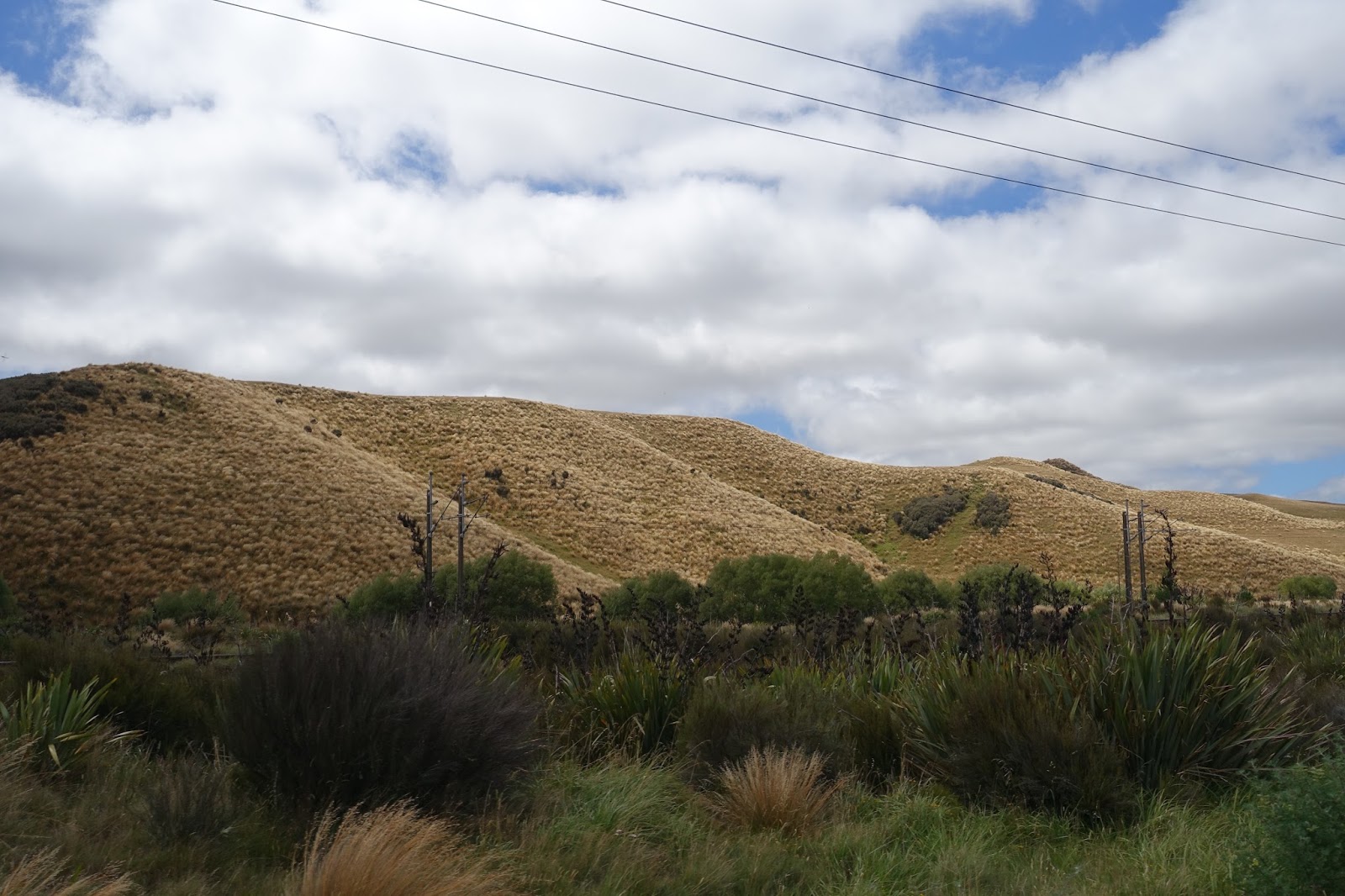
The hills densely covered with NZ's signature sheep

Tuesday, March 01, 2016

Your body is a thermal wonderland

Part two of our visit to Rotorua's Wai-o-Tapu "thermal wonderland" park. Incidentally, although Rotorua is certainly a well-known tourist destination, I feel like I never see it on blogs or Buzzfeed-style "12 reasons not to visit New Zealand" lists. Is it something those of you who are unfamiliar with New Zealand have seen or heard of? Or does it fly under the radar unless you're actively researching a trip here?

Walkway over the sinter terraces (formed from silica deposits) next to the Champagne Pool

The Primrose Terrace, not a lake but a large mineral deposit


The Champagne pool is 65 metres across and 62 deep, with a surface temperatures of 74°C. I love the look of the steam rising off its surface, which is also quite the experience in real life, since it's (unsurprisingly) warm and pungent. A steam bath is not quite what you want on a hot summer's day, but we couldn't resist lingering around the rim for plenty of photos.

The colours of the lake are due to mineral deposits including gold, silver, mercury, sulphur, arsenic, thallium, and antimony, and the crust around the lake is due to earthquake activity (the lake itself was formed only 700 years ago in a hydrothermic eruption). These photos, by the way, have not been enhanced - it really is that colour!


The Champagne Pool is probably the most spectacular sight in the park, but by no means the only feature. Nearby, for example, is the "Devil's Bath", which owes its bright colours to overflow water from the Champagne Pool mixing with sulphur and ferrous salts in its crater.


The Frying Pan Flat, possibly
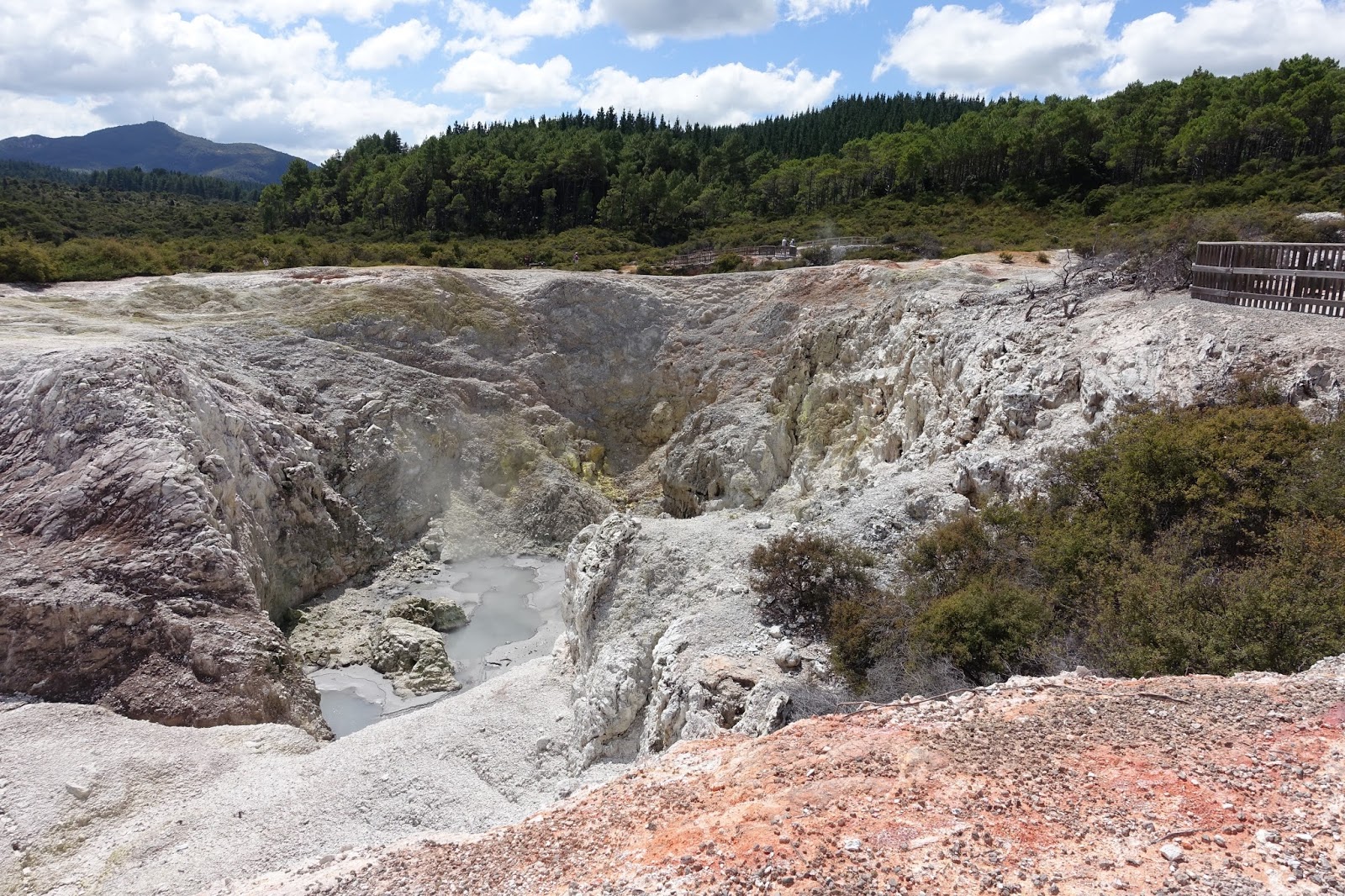
The Devil's Home, a collapsed crater where the devil hangs out between baths

Jules and one of the Devil's Ink Pots, mud pools coloured with crude oil and graphite.

The Inferno Crater

The Jean Batten Geyser. The first woman to fly both ways between Australia and England, she must have been particularly honoured to have this named after her instead of the devil.

Jules by the Alum Cliffs
As you can imagine, by the time we had made our way around all of these sights, we were pretty hot, tired and hungry. Then we discovered one of the true joys of motor homing - there was our kitchen and living room, right there in the carpark. We stopped for a gourmet lunch of tacos before heading to Taupo, a short way away.