Thursday, November 02, 2017

PA system

I had one reason for going to Arezzo: Piero della Francesca. In my last year of high school, I took Art History, and two of the major works we studied were the fresco cycles of the Brancacci Chapel in Florence, painted mostly by Masaccio, and the Legend of the True Cross, by Piero della Francesca. I committed these to memory for my exams as Marlon Brando - Masaccio Brancacci - and Public Address system - Piero Arezzo. Some may say those are not the cleverest mnemonics ever devised, but who's the one who still remembers this literally half my lifetime ago (jeez)?

Even as a 17 year old in little old New Zealand studying these art works on dodgy photocopies, I probably thought I'd get to Florence one day (and I did, 9 years later), but I perhaps I didn't have so much faith I'd end up in Arezzo. I probably didn't even know where it was. So being able to include it on my honeymoon itinerary was pretty special.

I made us wake up early in Siena so we could drive to Arezzo and be there shortly after the Basilica of St Francis, which houses the frescoes, opened. I even made sure we bought our timed ticket in advance, because on the internet it says you're only allowed maximum 25 people for half an hour at a time in the chapel and I was basically in a blind panic about missing out on fresco-gazing time. (Actually, there weren't many people there, so they let us in early and we stayed about 45 minutes total.) Jules was under instructions to calm me down, and his services were required, telling me to actually stop and look at the art instead of just taking a million photos. But I also took a million photos.

That famous Tuscan early morning mist on the way to Arezzo. In reality, someone was burning rubbish or something, thus producing this picturesque effect. But don't tell anyone.
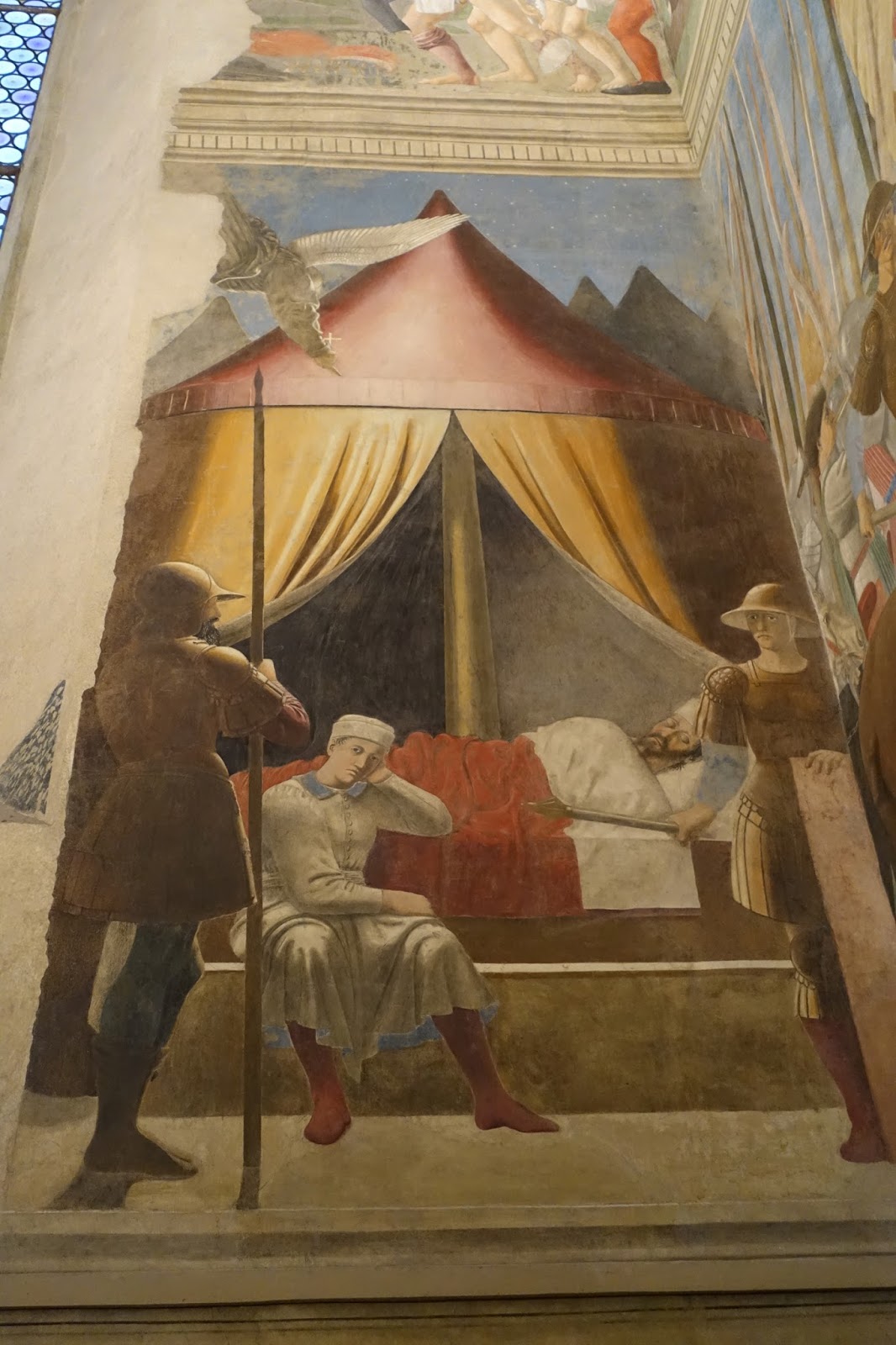
Piero della Francesca was active relatively early in the Renaissance. He began work on the Legend of the True Cross in 1452, the year Leonardo da Vinci was born. Thus, although his works are now faded and perhaps less striking than some later works, they represent a great deal of innovation in their use of space and perspective, and they have a sort of gracious, contemplative calm to them which is very attractive.

The Legend of the True Cross tells the whole story of the cross Jesus was crucified, from its origins, growing from a seed of the tree in the Garden of Eden, to its adoration by the Queen of Sheba, to the time of Constantine, who dreamed of the sign of the cross and went on to win a victory in its name, followed by its rediscovery by his mother Helena. Oddly enough, it doesn't include a crucifixion scene, which one would have thought was a pretty key part of the story, but it throws in a bonus Annunciation.

The chapel is pretty small!


The annunciation. The trompe l'oeil bar passing through a loop at the top right (somehow?) represents Mary's unbroken virginity


Details from the Battle of Heraclius and Chosroes, one of the miracles associated with the cross

My favourite of the frescoes - the Dream of Constantine. The soldier's watchful expression and the soft glow of the tent draw you in from the other side of the room

A less savoury part of the legend, in which a Jew who was the only person who knew the whereabouts of the cross is tortured to reveal its location

The Queen of Sheba worships the beam which she recognises as the True Cross

The three crosses - that of Jesus and the two thieves - were found together. The True Cross is recognised by performing a miracle of resurrecting a dead man
Elsewhere in the Basilica, we found a mural of the Miracle of the Mule. The story goes that a heretic told St Anthony of Padua that he would only believe in Christ's presence in the Eucharist if his mule would bow down to it. Apparently, mules need some persuasion (stubborn as what again?), so he starved the mule for three days and then, in classic sitcom style, St Anthony and the mule's owner stood on either side, one beckoning him with tasty fodder, the other with the Eucharist. Much like Santa's Little Helper, the mule chooses wisely, and bows down to the Host, as captured in this charming (non-Piero) fresco:


We came across this street art version of Piero's portraits of the Duke and Duchess of Urbino (originals in the Uffizi).

Tuesday, October 31, 2017

Team Onda

As well as its cathedral, Siena is famous for the Palio horse race, which takes place twice per year in July and August. The race comprises three laps of the famous (and quite small for a horse race, it seemed to me) Piazza del Campo, and usually lasts around 90 seconds.

The Palazzo Pubblico with the Torre del Mangia
The square is a popular place to hang out, day and night

I wasn't particularly upset to miss out on seeing the Palio - I'm sure it's fun, but it also sounds like a bit of an overcrowded nightmare. What I didn't realise though, was that we still managed to turn up on a bit of a special weekend for Siena, or at least for one part of the city.

The Palio is disputed between the different districts, or contrade, of the city. There are 17, with pretty cool names and emblems - eagle, caterpillar, snail, owl, dragon, giraffe, porcupine, unicorn, wolf, ram, nicchio (whatever that is?), goose, panther, forest, tower, turtle and wave. We happened to be staying in the wave, or Onda district. And it just so happened that Onda were victorious in the 2017 palio, and they were celebrating their victory the weekend we were there, with the streets liberally festooned with their dolphin symbol. Although we saw some signs of the other contrade, they weren't nearly as visible as Onda, so I'm not sure whether they went over the top to mark the victory or whether they just have more Onda pride year-round. Either way, we are now Team Onda 4 lyfe.

It's pretty cool to see a tradition like this, with medieval origins, still going and still such a part of people's identities. We saw different city districts with names and symbols in other parts of Italy too, but it seems no-one takes them quite as seriously as the Sienese!

A dolphin Onda fountain
Friday night celebrations in Onda town
Onda torches and flags leading in to the Piazza del Campo

Another piggy friend

A faithful dog beneath the bough, a glass of wine and thou 

Saturday, October 28, 2017

OPA Siena style

There is quite a confusing array of ticket options to visit the duomo. We went for the OPA Si pass + Gates of Heaven, which includes the roof tour, cathedral, Piccolomini library, baptistery, crypt, museum and panoramic view. I was slightly miffed that the duomo and library and museum and panoramic view are not actually ticketed separately, so the joint ticket doesn't really include 7 separate sights, but that's just me being petty really.

The Piccolomini library is a small but fabulous annex to the cathedral, featuring an amazing ceiling and Pinturicchio frescoes of the life of Pope Pius II (born Aeneas Silvius Piccolomini).


There was a really clever use of the real architectural space, such as these corner frescoes joined by the decoration so they almost look like they're on one flat wall

The figure with the red pants is reputedly a young Raphael, with the fresco's painter Pinturicchio beside him. Raphael may also have worked on the frescoes 

Next up was the Baptistery, built in the early 14th century and decorated mostly by Vecchietta in the 15th C.

The ceiling frescoes show the Articles of Christian Faith


After lunch, we ticked off the museum and the "unfinished façade", which you can climb for a great view of the Duomo and Il Campo (and the rest of Siena). We had to queue a little while to go up, because they only let a small number of a time up (space is limited up there), but it's worthwhile for the views.

In front of the Torre del Mangia in the Piazza del Campo

Selfie with the Duomo behind us
It took me a while to work out that I was meant to be posing like the blurry group behind, not just showing off the ring
The Duomo from the Unfinished Façade


Original statues and stained glass from the Duomo
Lastly, we visited the Crypt under the cathedral, which is decorated with brightly-painted 13th century frescoes. The coolest thing about this was it was only discovered in 1999. It's not huge and my pictures didn't come out very well because of the light, but it's pretty neat to see something that lay secretly below the cathedral for so long until so recently. There was also a group of 7 old French people in there who spent the entire time we were down there arguing about how to split the 2€ cost of listening to an audio description of the crypt between 7 people. If I were in a sitcom, I would have just given them the 2€, but being normal people, we just rolled our eyes.


Sunday, October 22, 2017

The gates of heaven

It felt like there were fewer tourists overall in Siena than in Florence, but they were more heavily concentrated, due to the much smaller size and because there is really one pre-eminent tourist attraction to visit - the cathedral and its associated sites, so everyone was funnelled in there together.


We were no exceptions to this rule, and went for the full-on cathedral experience with all the bells and whistles, starting with the "Gates of Heaven" tour, which takes you into the rafters to see the cathedral from above.


The amazing floor mosaics are best enjoyed from above!


By the time we had finished the tour, it had started to fill up quite a bit in the cathedral below. Of course, it would be great to see it in peace and quiet, but it's hard to detract from such a beautiful building. Just the black and white columns alone are stunning.


Mosaic of Siena at the centre of Italian cities (not sure why they get Romulus and Remus)


Busts of the popes line the ceiling 


We had a full day of duomo and duomo-related activities, but I think that's enough for one post!