Monday, November 13, 2017

Cats, cathedral, caves in Orvieto

The middle portion of our trip can basically be summed up as a series of hill towns, mostly known primarily for their churches - San Gimignano, Siena, Arezzo, Orvieto and Assisi. Orvieto had been on my bucket list for a while, purely because of the beauty of its cathedral's facade. Our overnight stay here was probably sufficient, but we discovered that there was much more to Orvieto than just a facade.

On the city walls

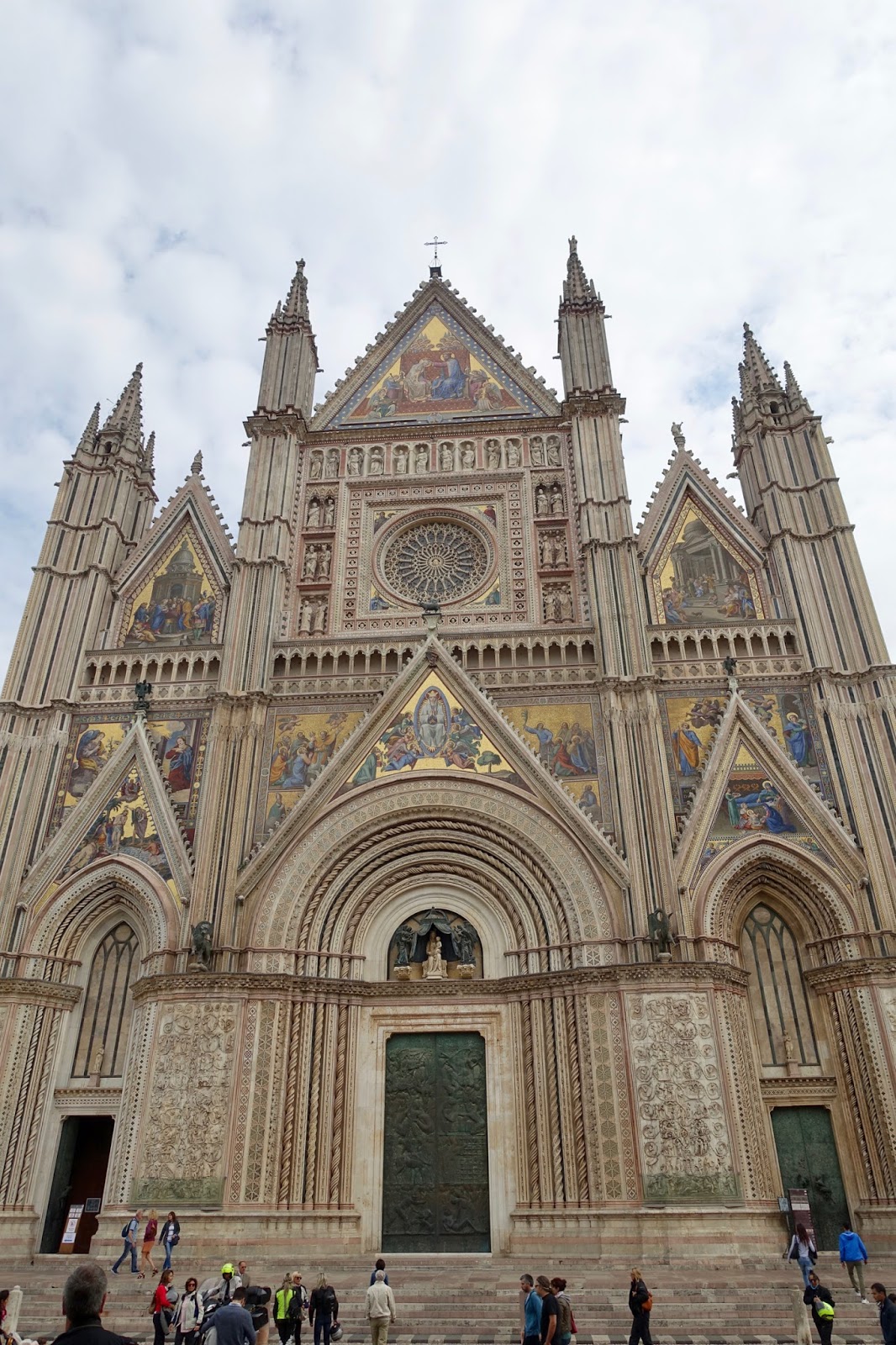
The fabulous duomo was constructed from the late 13th century essentially to house a holy relic. Legend has it that a priest was conducting Mass at Lake Bolsena, not far from Orvieto, when blood began to drip from the Eucharist and stain the altar cloth below. The cloth was taken to Orvieto, and some 30 years later it was decided that a much more magnificent church was required to house this relic. While the black and white stripes of the duomo walls and pillars are reminiscent of Siena's cathedral, it's that famous Italian Gothic facade that really sets it apart.


The cathedral boasts elaborate carving around the doors, telling Bible stories to the illiterate

Adam and Eve, someone (Abel?) about to get a good axeing, and someone uncomfortably squished under a bush

Death was never far away

Modern sculpture on the cathedral doors: for once, not hideous


Compared to the elaborate facade, the interior of the main part of the cathedral is rather simple. But the side chapels host more treasures


 Firstly, there is the Chapel of the Madonna di San Brizio, largely decorated by Luca Signorelli in the 15th century. Most of the paintings here concern the apocalypse and the last judgement.

The ceiling was decorated by Fra Angelico and Gozzoli before they were called away to Rome to work on other projects


This fresco depicts the preaching of the Antichrist, the figure standing on the plinth in the centre. He resembles Christ at first glance, but you can see the devil behind him whispering in his ear. The fresco would have recalled the recent execution of Savonarola for heresy. It is also notable for the inclusion of famous figures from Italian art and culture. The central figure in blue and burgundy is Raphael, and the two figures on the lower left are Signorelli himself and fellow artist Fra Angelico, in his monk's habit. Others in the crowd include Christopher Columbus, Boccaccio, Petrarch and Cesare Borgia.

The lower portion of the wall features famous artists and philosophers in dramatic poses, as if watching the apocalyptic events above


The Damned are taken to Hell and recieved by Demons shows people being dragged to hell by human-like demons, whose true nature is revealed by the lurid tones of their decomposing flesh.


A happier scene for the Elect, who are taken to paradise by musical angels.


This one looks grisly, but the nudes climbing out of their graves are being called by the angels to the Resurrection.


Almost sci-fi scenes of the End of the World are depicted over the doorway.

The other, and older, chapel (the Chapel of the Corporal) was built in the 14th century to house the holy relic. It contains frescoes showing the history of the Eucharist and miracles connected to the bleeding Host.


The Eucharist here literally depicted as Jesus' flesh


We also explored the museums attached to the duomo, which hold Etruscan art, some original statues from the cathedral facade, and works by Emilio Greco, who made the modern cathedral doors.

Statue of Mary from the facade

Monkey see, monkey do

The vaults under the cathedral

Just imagine this thing leaping on your back

Apart from the cathedral, Orvieto is also known for its Etruscan past and its underground world. We took a guided tour of the caves, which are mostly manmade and date back 2,500 years at the oldest. They were used for storerooms, to dig wells, and spaces to produce olive oil and grind grain (land up on the hilltop was always at a premium, and in fact the population of medieval Orvieto was much greater than the modern city) and as a space of refuge and preparation for sieges. Even today, almost every private home or business in Orvieto has its own cave - around 1200 in total - but the caves on the very edge of the hilltop are now public land, due to being abandoned by their owners because of the threat of erosion.

The land around the caves was popular with cats, sadly it seemed a popular place for people to abandon them :(


This was the coolest part of the tour. The niches in the walls were built to house doves/pigeons, essentially as insurance for times of siege, when the city would be cut off from the farmland below. As these caves are on the edge of the cliffs, windows allowed the pigeons to come and go, feeding and watering themselves outside, and coming inside to lay eggs and, eventually, get eaten. Perfect low-maintenance food sources.

Capping off our time in Orvieto, at evening we had my favourite dish of the trip - local umbracelli pasta - thick, handmade noodles - with mint and courgette (and presumably a bit of cheese). Simple, but fabulous. Can be enjoyed in Il Giglio d'Oro, right next to the cathedral, if you should find yourself in Orvieto.

Saturday, November 04, 2017

Intermezzo in Arezzo

Since I insisted on rushing to the Basilica in Arezzo so early in the morning, by the time we had finished there and checked in to our B&B it was still only mid-morning. We had seen a market setting up on our way to the Basilica, so the first order of business was to wander the streets on a lovely Sunday morning, checking out antiques and bric-a-brac. This was followed by lunch - a rather dry porchetta sandwich for me (the bread in general left something to be desired in Italy), while Jules had the typical Tuscan speciality of lampredotto i.e. tripe sandwich. Dry was definitely not the word here, it was pretty overwhelmingly dripping and mushy with its tripe stew filling. I had a bite but it was a bit much for my stomach. A stringy piece of entrails fell out and even the birds rejected it. Jules soldiered on, but I had to look away in order to finish my sandwich without getting sick!


Perfect present for a child you hate

I think this might be the most Italian photo ever... The alley, the vespa, the sign reading "Johnny Bruschetta"...
After lunch we visited the Casa Vasari, home of one of Arezzo's most famous sons, the painter, architect and writer Giorgio Vasari. While Vasari is most well known now for his Lives, a gossipy history of fellow famous artists of the Renaissance, we had just encountered his work in the Palazzo Vecchio in Florence, where he executed some works and directed the overall decoration. He also began the construction of the Uffizi gallery.

The Casa Vasari is not his childhood home (as with the Raphael house we visited later on in Urbino), but rather a house he bought in his home town at the age of 30, in 1541. He was already active as a painter, working and studying in Florence, Rome and elsewhere, by this time, and it took him until after 1568 to complete its decoration.

It's pretty small, but there are some beautiful works, especially in the main salon:


We stopped in the park next to the Duomo for a rest and a gelato - like most of the towns in this part of Italy, Arezzo is built on a hill and there's a lot of steep climbs up and down to get anywhere. It gets bonus points for having outdoor escalators that took us plus suitcases up from the carpark into the city itself. Then we visited the Duomo itself, which is pretty enough but fairly unremarkable by the high standards of Italian cathedrals.


Our final stop was the Medici fortress, which offers some lovely views although there's nothing really left of the inside. There was a pretty cool art exhibition on while we were there, which definitely fit with the gloomy fortress feel.


Looking across the large city cemetery

After all this, we were too tired for anything other than pizza and Netflix in our hotel room, which is not too bad a way to spend an evening, after all.

Thursday, November 02, 2017

PA system

I had one reason for going to Arezzo: Piero della Francesca. In my last year of high school, I took Art History, and two of the major works we studied were the fresco cycles of the Brancacci Chapel in Florence, painted mostly by Masaccio, and the Legend of the True Cross, by Piero della Francesca. I committed these to memory for my exams as Marlon Brando - Masaccio Brancacci - and Public Address system - Piero Arezzo. Some may say those are not the cleverest mnemonics ever devised, but who's the one who still remembers this literally half my lifetime ago (jeez)?

Even as a 17 year old in little old New Zealand studying these art works on dodgy photocopies, I probably thought I'd get to Florence one day (and I did, 9 years later), but I perhaps I didn't have so much faith I'd end up in Arezzo. I probably didn't even know where it was. So being able to include it on my honeymoon itinerary was pretty special.

I made us wake up early in Siena so we could drive to Arezzo and be there shortly after the Basilica of St Francis, which houses the frescoes, opened. I even made sure we bought our timed ticket in advance, because on the internet it says you're only allowed maximum 25 people for half an hour at a time in the chapel and I was basically in a blind panic about missing out on fresco-gazing time. (Actually, there weren't many people there, so they let us in early and we stayed about 45 minutes total.) Jules was under instructions to calm me down, and his services were required, telling me to actually stop and look at the art instead of just taking a million photos. But I also took a million photos.

That famous Tuscan early morning mist on the way to Arezzo. In reality, someone was burning rubbish or something, thus producing this picturesque effect. But don't tell anyone.
Piero della Francesca was active relatively early in the Renaissance. He began work on the Legend of the True Cross in 1452, the year Leonardo da Vinci was born. Thus, although his works are now faded and perhaps less striking than some later works, they represent a great deal of innovation in their use of space and perspective, and they have a sort of gracious, contemplative calm to them which is very attractive.

The Legend of the True Cross tells the whole story of the cross Jesus was crucified, from its origins, growing from a seed of the tree in the Garden of Eden, to its adoration by the Queen of Sheba, to the time of Constantine, who dreamed of the sign of the cross and went on to win a victory in its name, followed by its rediscovery by his mother Helena. Oddly enough, it doesn't include a crucifixion scene, which one would have thought was a pretty key part of the story, but it throws in a bonus Annunciation.

The chapel is pretty small!


The annunciation. The trompe l'oeil bar passing through a loop at the top right (somehow?) represents Mary's unbroken virginity


Details from the Battle of Heraclius and Chosroes, one of the miracles associated with the cross

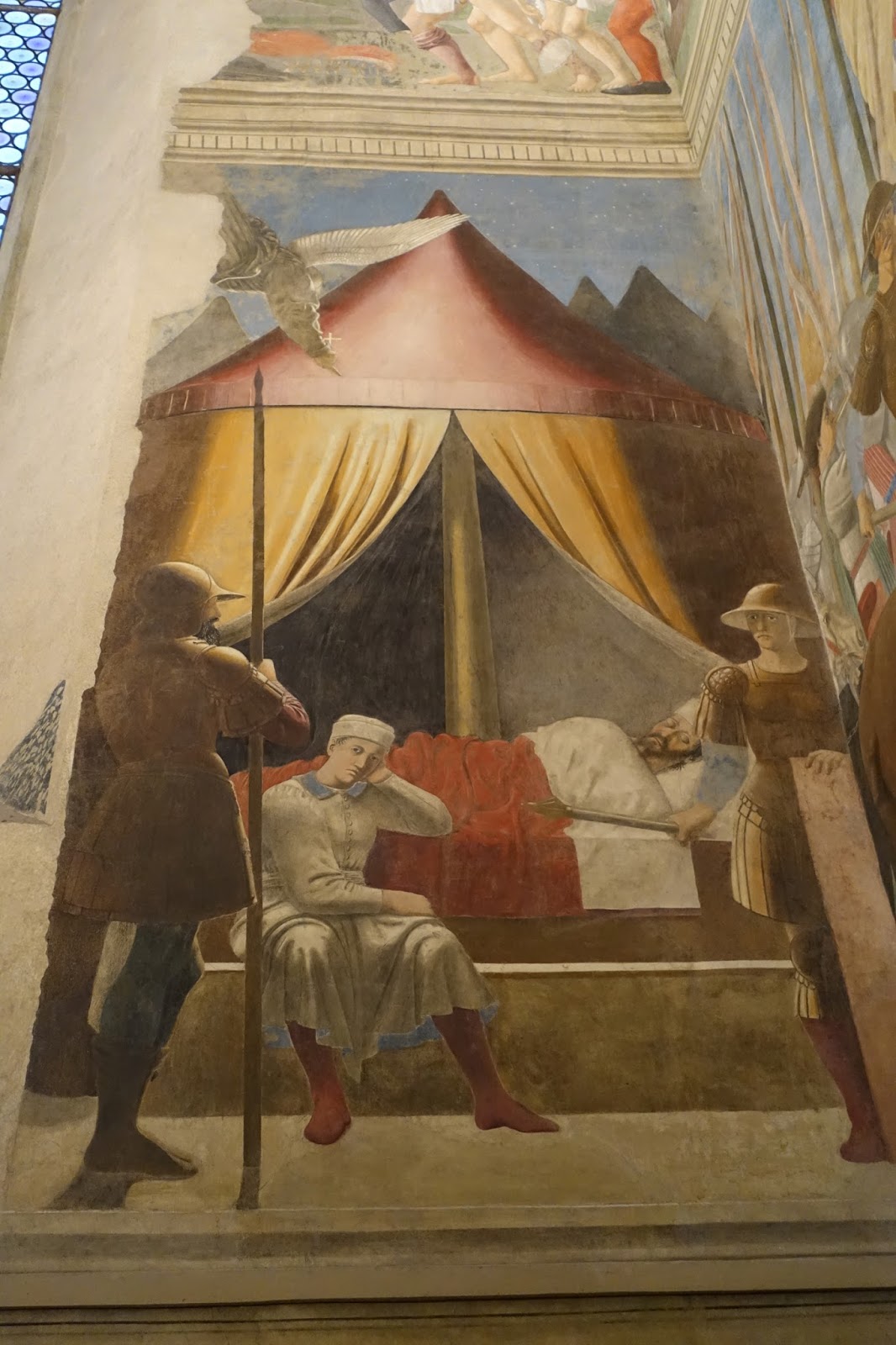
My favourite of the frescoes - the Dream of Constantine. The soldier's watchful expression and the soft glow of the tent draw you in from the other side of the room

A less savoury part of the legend, in which a Jew who was the only person who knew the whereabouts of the cross is tortured to reveal its location

The Queen of Sheba worships the beam which she recognises as the True Cross

The three crosses - that of Jesus and the two thieves - were found together. The True Cross is recognised by performing a miracle of resurrecting a dead man
Elsewhere in the Basilica, we found a mural of the Miracle of the Mule. The story goes that a heretic told St Anthony of Padua that he would only believe in Christ's presence in the Eucharist if his mule would bow down to it. Apparently, mules need some persuasion (stubborn as what again?), so he starved the mule for three days and then, in classic sitcom style, St Anthony and the mule's owner stood on either side, one beckoning him with tasty fodder, the other with the Eucharist. Much like Santa's Little Helper, the mule chooses wisely, and bows down to the Host, as captured in this charming (non-Piero) fresco:


We came across this street art version of Piero's portraits of the Duke and Duchess of Urbino (originals in the Uffizi).