Friday, November 13, 2015

Millau, m'lady

On the way from Albi to Lyon, I sort of stole my Dad's ambition by visiting the Viaduct of Millau. We first got to see it from underneath, where there is a visitor's centre which takes guided tours inside one of the pillars, the tallest of which is 343 metres, making it the world's tallest bridge. Unfortunately, the tours only took place once an hour (or maybe once every half an hour, but whatever it was, it would have meant a long wait), and you weren't allowed to go outside on the side closest to the gorge without being on a tour, so it wasn't the best view.

We were going to just continue on our way, which actually didn't involve going over the viaduct, but we decided that since we had taken a detour to see the bridge, we may as well. This was lucky as, although driving over the viaduct itself wasn't so spectacular (it has high railings so you can't really see down over the sides), there is another visitor's centre on the far side of the bridge where we could actually get out and take photos of the whole thing. It's a pretty impressive feat.

The bridge from underneath

Driving over the viaduct

The view from the other side


Our route thenceforth to Lyon (we drove via Le-Puy-en-Velay, home of the famous lentils and also a large statue of the Virgin Mary) took us through the Massif Central. I had never been to this area, which apparently covers 15% of France, before, perhaps because there's not a lot there, really. Jules's French colleague told us it was known as the 'diagonale du vide' (empty diagonal) due to the low population densities and lack of large cities. It was fairly empty, but also very beautiful. It was really strange seeing the GPS telling us we were nearly a thousand metres up, yet be surrounded by green pastures and what was often flat land (with mountains on the horizon). I don't know what it looks like in winter, but in September you could have fooled me that we were at sea level most of the time.

High in the Massif Central

Tuesday, November 10, 2015

Albi back

We used Carcassonne (the lower city) as our base for visiting the region from Sunday to Wednesday, and on Thursday we headed north for a night in Albi. I had been obsessed with visiting Albi since I read about the city in the book about the Cathars. I had forgotten this, but when I mentioned Albi to my friend Liz, she rolled her eyes and said that when we drove past on the way to Toulouse, I treated the whole car to a lecture on the city. It's a wonder I have any friends at all. That was back in 2013, but clearly the ambition to visit the city hadn't died, and I made sure it was on our itinerary this time round.

It's not the biggest or most happening place, but it is really pretty, especially if you take a stroll on the river bank, enjoying the view of the cathedral and 11th-century stone bridge (which I think is the one in the background of the photos below).


I love the light in this one, the moody clouds did rain on us a bit, but made for dramatic photos


The main reason I had for visiting, though, was to see the cathedral. I think the photos above probably don't give a good idea of its scale. In a word, it's fricking massive. And really unusually shaped from the front, like some sort of strange titanic ship (but not the Titanic...) The Sainte Cécile cathedral, to give it its formal name, was built between the 13th and 15th centuries and claims to be the largest brick building in the world. The reason for the church's forbidding exterior is supposedly to symbolise the triumph of the church militant, commemorating its victory over the Cathars and reminding all who saw it of its might, both spiritual and earthly.


The bell-tower is 78 metres tall
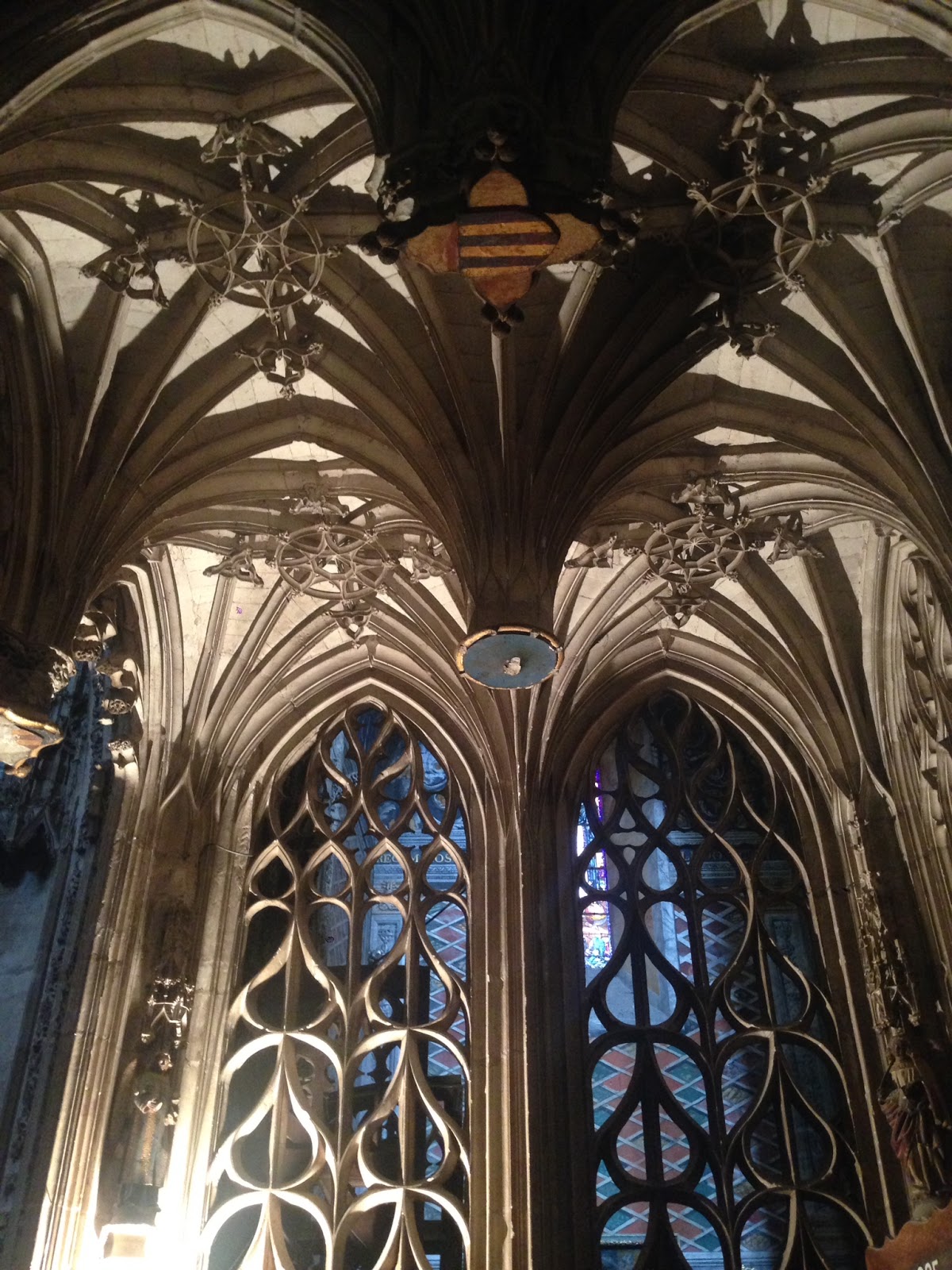
What you wouldn't expect from the built-like-a-brick-you-know-what outside is the amazing interior. The austerity of the external architecture is completely forgotten when you step inside, with every surface covered in paintings, trompe-l'oeil decorations, carving and statues. Everything looks so dull and muted in photographs, but it was one of those breathtaking places where you hardly know where to look, so lovely is it in every direction.

Looking towards the rood screen, one of the few surviving examples in Europe that separated the areas reserved for those in orders and the rest of the congregation

The ceiling, which apparently represents the oldest and largest group of Italian Renaissance painting in France

The best impression I could capture of the painting which covered every surface

A close up of the beautiful stonework on the rood screen

Frescoes of the Last Judgement. To give an idea of scale, counting the doorway (which cut through the original fresco), the paintings here cover nearly 200 square metres
We also took an audio tour of the area behind the rood screen, which is full of amazing statues and carvings (it was too dim for these to really come out on photographs). I swear the audioguide went out of its way to be enormously boring, even for a huge nerd like me, but it's pretty. The treasury, upstairs, can be skipped, although I did find 20€ lying on the floor up there, so it lived up to its name.

We had a great dinner in the town, another cassoulet, but this time "à l'ancienne", made with pois carrés (square peas), which are mysterious little customers. As far as I can tell (Wikipedia came up with two options in French for pois carré), they may be known as grass peablue sweet peachickling vetchIndian peaIndian vetchwhite vetch in English, but since I haven't heard of any of those things, it doesn't help much. Frankly, the traditional lingot beans were nicer, but the pois carrés had a bit of a crunch and a nutty taste which was not unpleasant for a change.

Thursday, November 05, 2015

Cathar country continued: Peyrepertuse and Quéribus (aka amazing views)

I didn't want to overload with too much information earlier on, but maybe I should have said something earlier about what the whole Cathar heresy was about. It was basically a dualist outlook, which divided the universe into good and evil, each ruled over by a Good God and an Evil God respectively. The Cathars identified all of the material world as falling under the sway of the Evil God, and hence rejected any materialism such as sex or the accumulation of wealth, at least for the priestly Perfect class. Since they rejected the physical body as a creation of the Evil God, they treated men and women equally, as genderless spirits trapped in physical bodies. The Catholic Church, with its vast material wealth, perhaps understandably did not take too kindly to these doctrines and launched the Albigensian Crusade against them in 1208. The rest is long and complicated history, but finished up with the Cathars being more or less wiped out and the formally fairly independent rulers of southern France, most of whom were not actually Cathars themselves but were tolerant towards them, being either deposed or brought firmly under the control of the French crown.

The stand-out visit of our trip was to the château of Peyrepertuse, which lies at an altitude of about 800 metres in the foothills of the Pyrénées. Although in ruins, it covers an area as large as Carcassonne, and is today divided into two distinct areas, which I think are the main castle and the keep, which offers amazing views of the main fortress and the valley below. The walk up is not as steep as at Montségur, but you do face a second climb up the Saint Louis staircase (named after the French king who further reinforced the site after capturing it in the crusades) to get to the keep.

Part of the climb up the St. Louis staircase


Looking down from the staircase to the main castle

There were spectacular views from the edge of the Keep area


After we climbed back down from Peyrepertuse, we headed to nearby Quéribus. Quéribus was definitely the smallest and least impressive-looking of the castles we visited on this trip, but it also gave amazing views of its surroundings, particularly as it is perched on its rock in a very compact way, allowing you to see in all directions. Peyrepertuse is visible from Quéribus and vice-versa, although I'm not sure you can pick out either in the photos I've posted. Its exposed position also meant it was extremely windy up there - not really the place to be wearing a light summer dress. I had to hobble up the stairs trying to hold it down most of the time we were up there.


Tuesday, November 03, 2015

Faire Lagrasse matinée

The day after Montségur, we visited the castles of Peyreperteuse and Quéribus, which I will blog about next time, but en route we stopped off in the small town of Lagrasse. I don't have too much to say about this, since we didn't go inside its ancient abbey (founded in 799), but it's well worth a stop to wander the narrow cobbled streets and enjoy the lovely scenery. It makes for some cute photos!

In front of the abbey


Not a good one for a claustrophobic

In front of the 12th-century stone bridge


Thursday, October 29, 2015

Cathar country continues: The siege of Montségur

When I told one of my colleagues we were planning a trip to the Cathar châteaux, his response was, "you know it's all ruins, right?" I did know, but was also pretty much caught up in the romanticism surrounding the sites. They've definitely done a good job of playing up the Cathar connections, even if in many cases they were apparently substantially renovated in the centuries after the crusades, by the conquerors. In the case of Montségur, an archaeological inspection in the 20th century concluded that "no trace" remained of the castle that was besieged during the crusades. The ruins that are there are still old, but 17th-century old, a far cry from the 13th century of the crusades. This is not prominently referred to on the tourist websites... However, there do still remain the ruins of some of the Cathar houses clinging to the current fortress wall.

Despite this, Montségur is perhaps the most evocative of the Cathar sites, at least by reputation. Seen as the last (major) stand of the Cathars, it was beseiged for nine months by the crusaders, who were unable to cut off supplies to the castle due to its naturally-defended location (walking up there, the mind boggles that they were able to haul supplies and building materials and so on up there, but apparently they did). Finally, though, they found a spot where they could build a catapult in range of the castle's defensive barbican and subsequently the castle itself. Finally, the besieged fortress surrendered, and while those who agreed to give up the Cathar faith were allowed to leave, around 215 Cathars gave themselves up and were burned alive at the foot of the mountain.

Myths and legends swirl around the castle today, such as that some of the Cathars escaped with a secret treasure, rumoured to be the Holy Grail. It is even often said that the Nazis were obsessed with finding the Grail, and someone hunted for it at Montségur on Himmler's orders, although it appears that this is as historically dubious as the original Grail story.

So while the castle as it is today might not be as old or mysterious as legend would have it, it still boasts impressive views of the surrounding countryside from its 1,200 metre perch. From the carpark, it's a vertical ascent of 250 metres to get to the castle, but it's all worth it when you get up there.

Before starting our climb

On the way back down

Inside the ruins

I love the layered look of each chain of hills stretching to the horizon

We didn't have the place quite all to ourselves, but it was pretty quiet up there


Photo taken by a friendly Australian

Monday, October 26, 2015

In Cathar Country: Carcassonne

Carcassonne is one of those magical names that you come across one day and then dream of visiting ever after. I'm not sure when I first heard of the city, famous for its ancient citadel enclosed by three-kilometre-long double walls, but it's definitely been on my bucket list for some time. Back in 2010, when I was living in Nice, I read a book about the Cathar crusades which opens with dramatic scenes of the siege of Montségur, another destination on our trip, which further piqued my interest in visiting the region. So way back in January, when Jules and I were discussing our travel plans for the year, I suggested a Languedoc roadtrip might be perfect, especially since he loves a good castle.

We drove down early from Beaune, with an unscheduled detour to the Pont du Gard, a large and allegedly beautiful Roman aqueduct. We had just wanted to stop off for a quick selfie, since we were running on a schedule to meet the people at our AirBnb and get the keys, but once we got there we found out you couldn't see the aqueduct from the road at all, and it cost 18€ to park the car, which seemed pretty excessive for what was meant to be a five-minute stop.

So, disgruntled, we were back on the road, arriving in Carcassonne around midday. As you can see, for the most part we had pretty moody weather, which was setting the pattern for the rest of our stay. In fact, it rained every place we stayed on the trip at least once (Beaune, Carcassonne, Albi and Lyon), which isn't really what you have in mind for the south of France.

We spent the first afternoon walking around the walls - as I said, they stretch around 3 km, so that took up quite some time - and then wandering through the streets of the citadel mostly looking for somewhere to have dinner. We managed to find a great place, with a delicious starter of beetroot and goat's cheese salad and then a yummy cassoulet for the main. I love a good cassoulet. I think we struck it lucky (or the careful consideration of the options paid off), because in general I imagine the Cité is probably too touristy to have good food as a rule.

The main streets inside the second wall were pretty busy, but I imagine not nearly as bad as it must be in July and August. According to the latest statistics I found, between 4 and 4.5 million people visited the citadel of Carcassonne in 2011, and I can only imagine it's increased since then. On the second day, we went inside the castle of Carcassonne, another layer of fortification inside the double walls. Since you have to pay to get into this part, only about half a million people visit each year, thus it's a lot less crowded. You also get to walk on portions of the walls which are otherwise inaccessible and there's a free guided tour, so it's worth doing if you have the time and inclination.

Of course, the citadel has been much restored over the years (apparently 30% is restored i.e. rebuilt and the slum-like dwellings dating back to the Middle Ages were razed), beginning with the intervention of Viollet-le-Duc in the 19th century, but you still can't help but be amazed by the size and completeness of the city and walls and by its turbulent (and confusing) history. In a nutshell, the fortified town was founded by the Romans, and some Roman walls and towers exist to this day. It used to stand on the border between France and Aragon, hence the need for its strong fortifications. It became the property of the Trencavel family in the 11th century, who built the castle inside its walls, and who would later shelter the Cathar heretics. Thus it got caught up in the Crusades, beseiged, and brought under the control of the French King. Much later on, the border moved and it became strategically unimportant, going into decline and ruin until Viollet-le-Duc intervened.


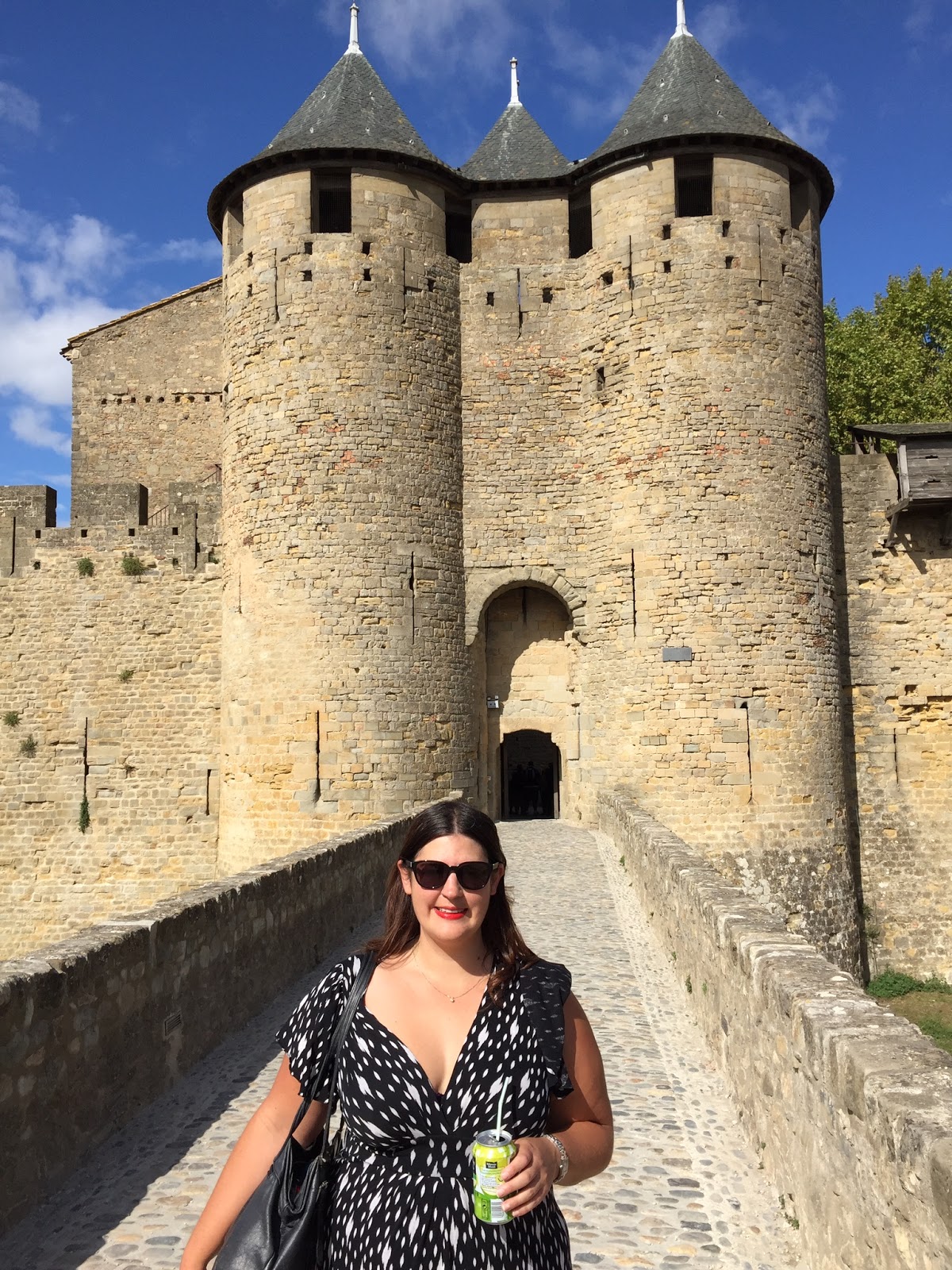
At the gate of the castle inside the citadel


A very nice lady took a nice photo of us, but failed to get anything interesting in the background

Between the two walls by night

Panoramic view of the walls and basilica